Machine Learning from Human Preferences

Chapter 1: Introduction

Overview

Machine Learning from Human Preferences explores the challenge of efficiently and effectively eliciting preferences from individuals, groups, and societies and embedding them within AI systems.

Overview

We focus on statistical and conceptual foundations and strategies for interactively querying humans to elicit information that improves learning and applications.
Overview

This class is not exhaustive!
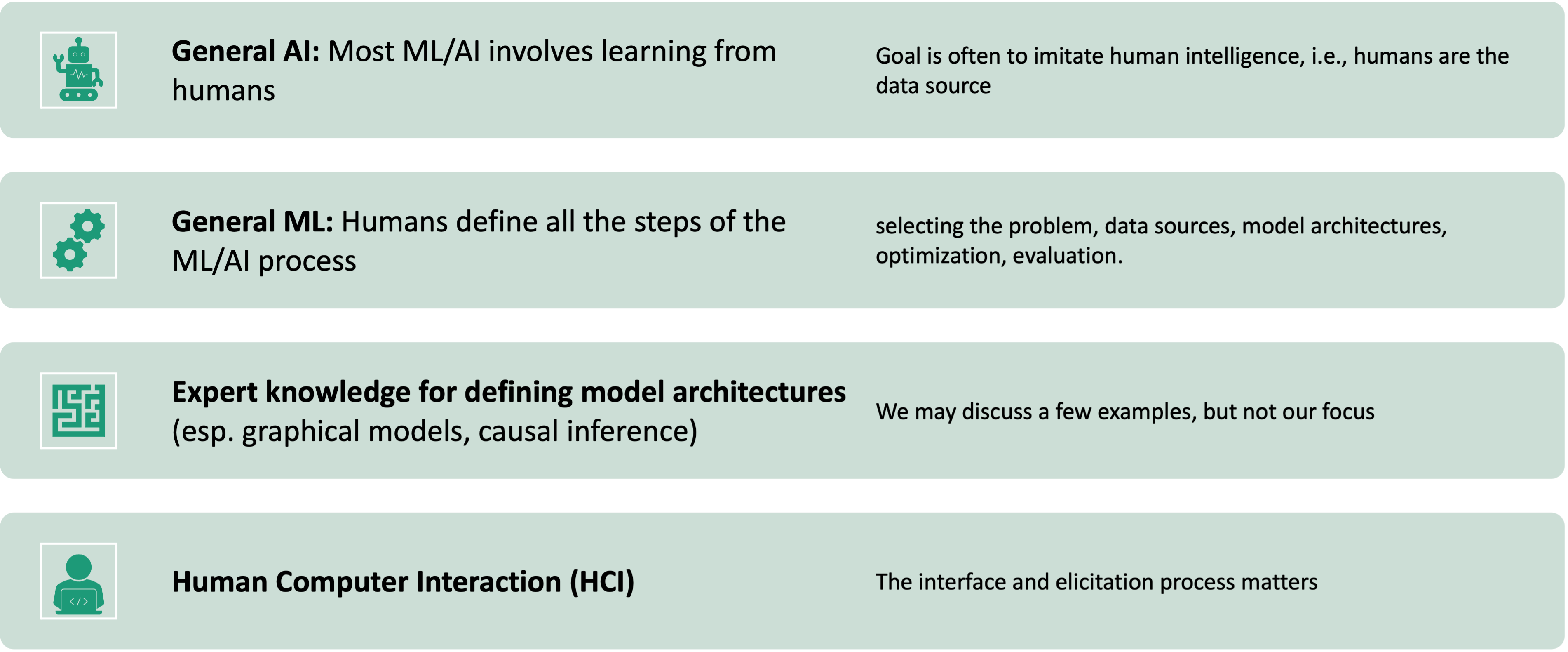
Overview

Feedback can be included at any step of training
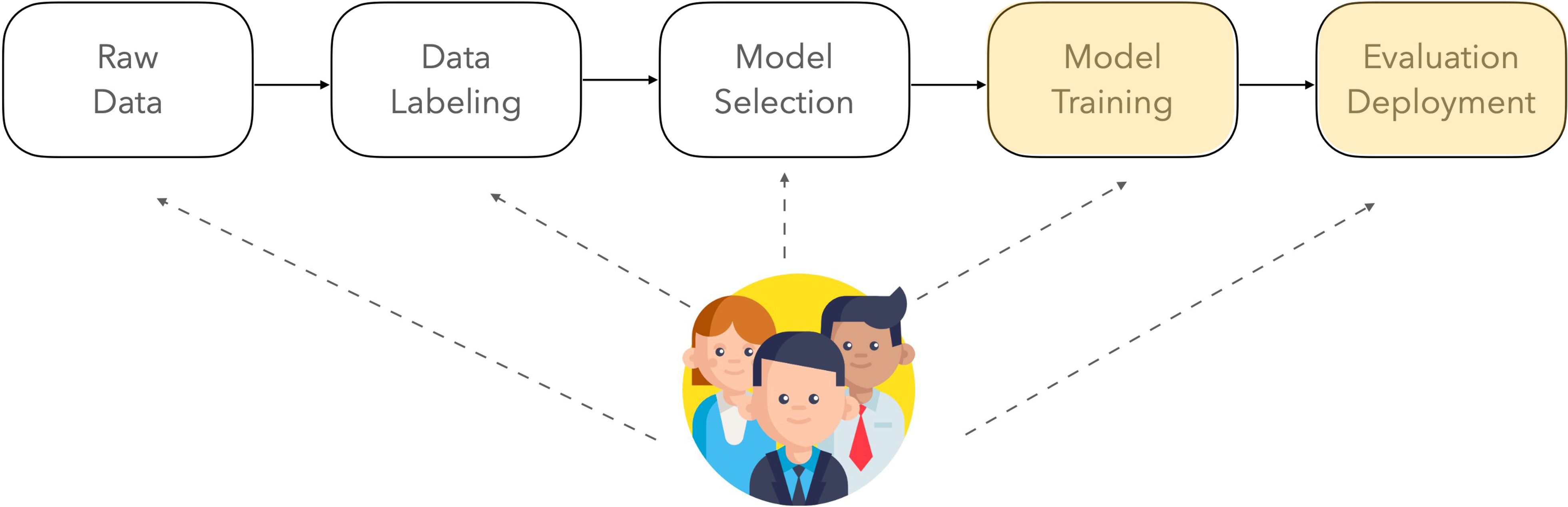
  1. Slides modified from Diyi Yang.

Overview

Feedback-Update Taxonomy

Dataset Update Loss Function Update Parameter Space Update
Domain Dataset modification, Augmentation, Preprocessing, Data generation from constraint, Fairness, weak supervision, Use unlabeled data, Check synthetic data Constraint specification, Fairness, Interpretability, Resource constraints Model editing, Rules, Weights, Model selection, Prior update, Complexity
Observation Active data collection, Add data, Relabel data, Reweighting data, collecting expert labels, Passive observation Constraint elicitation, Metric learning, Human representations, Collecting contextual information, Generative factors, concept representations, Feature attributions Feature modification, Add/remove features, Engineering features
  1. Slides modified from Diyi Yang.

Examples: Natural Languages
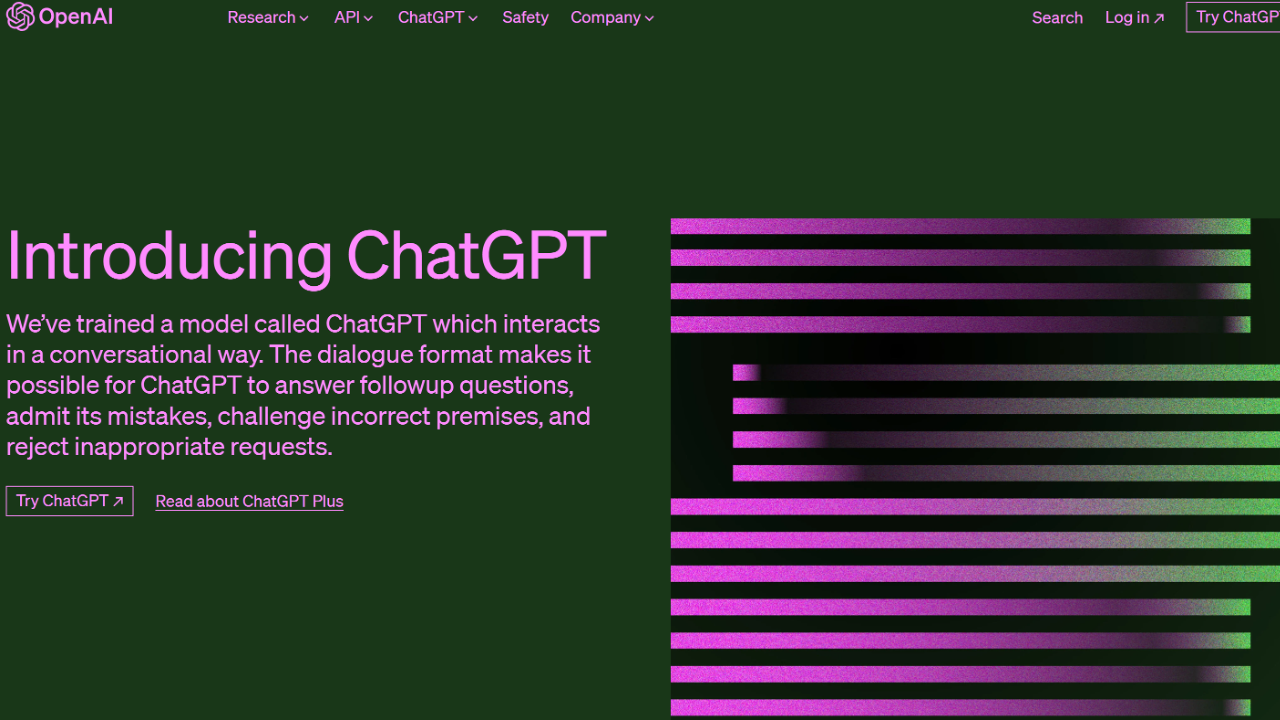
Examples: Natural Languages

Builds on research studying human feedback in language
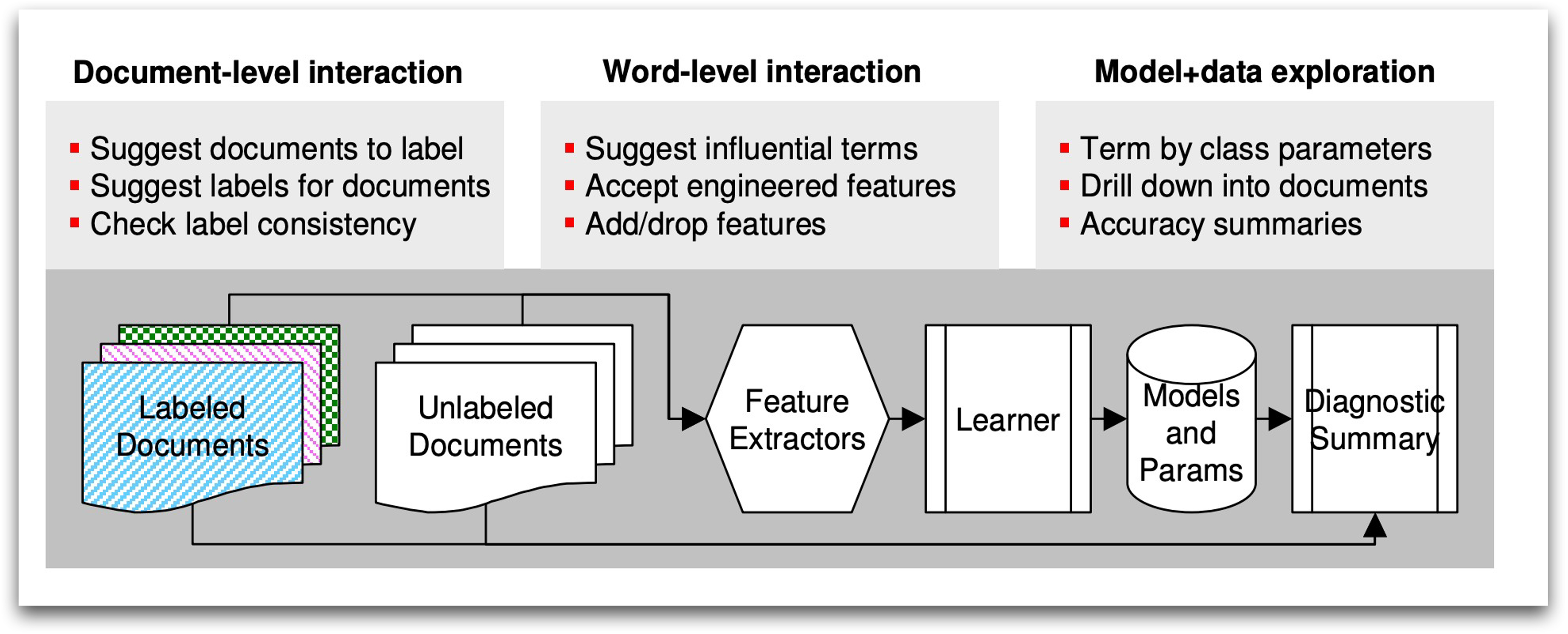
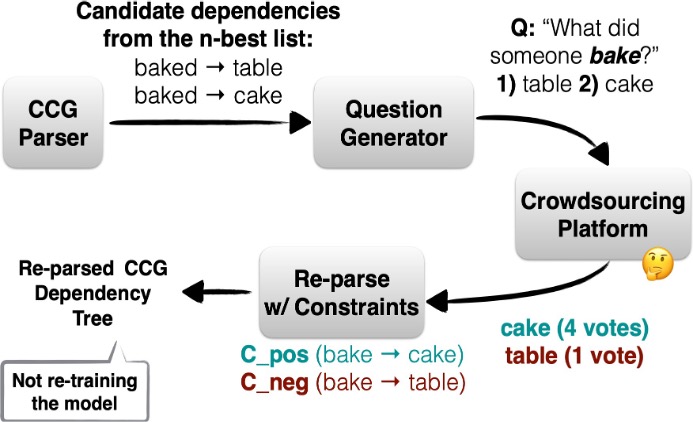
Harpale, Sarawagi, and Chakrabarti (2004)

Examples: Natural Languages
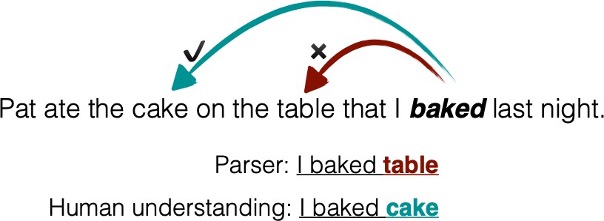
He et al. (2016)

Examples: Natural Languages
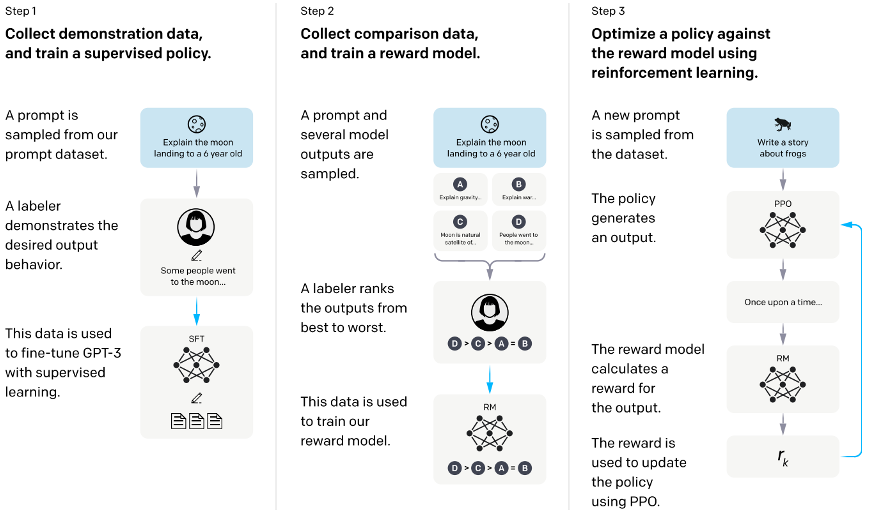
Ouyang et al. (2022)

Examples: Natural Languages

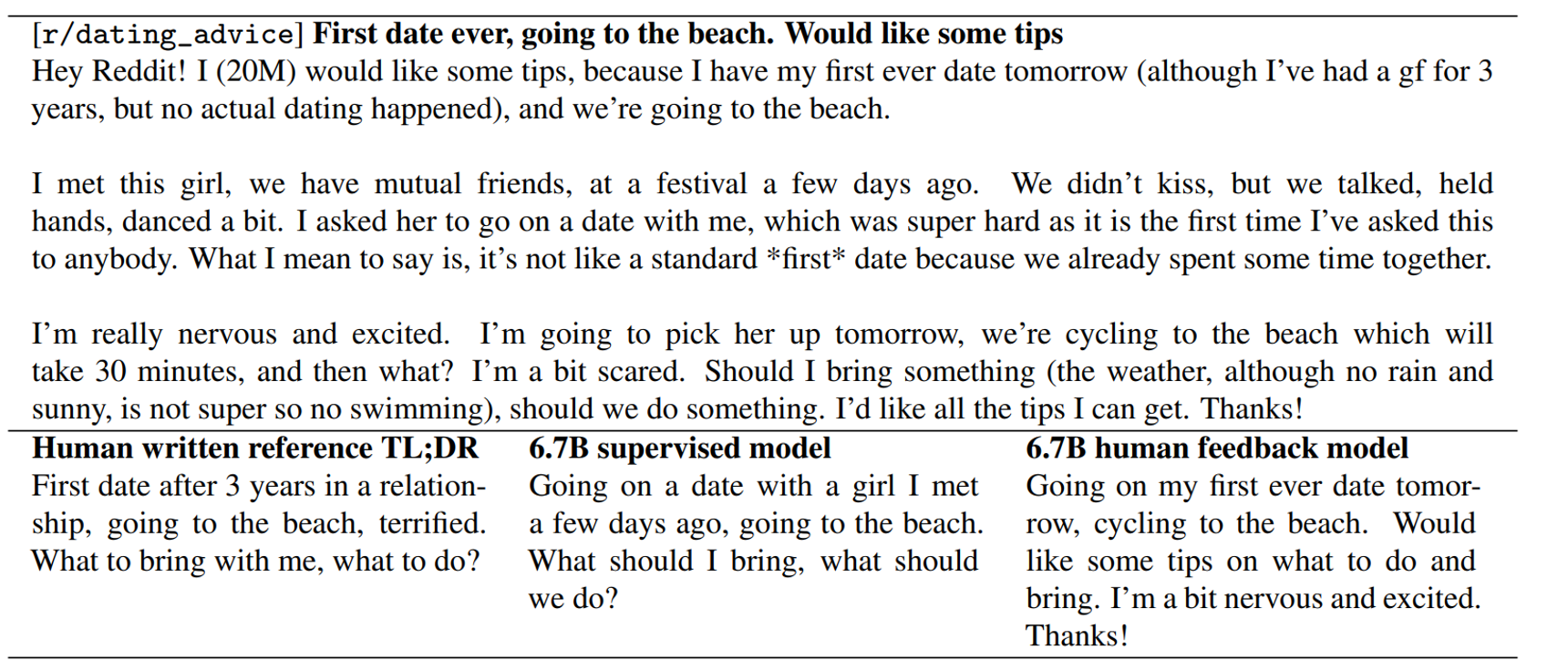
OpenAI Experiments with RLHF
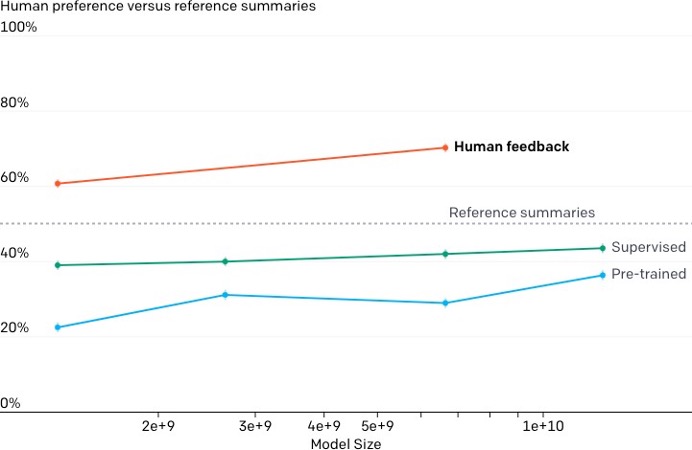
Stiennon et al. (2020)

Motivation

  • Provides a mechanism for gathering signals about correctness that are difficult to describe via data or cost functions, e.g., what does it mean to be funny?
  • Provides signals best defined by stakeholders, e.g., helpfulness, fairness, safety training, and alignment.
  • Useful when evaluation is easier than modeling ideal behavior.
  • Sometimes, we do not care about human preferences per se; we care about fixing model mistakes.

Motivation

We have not figured out how to do it quite right, or we need new approaches

  • Human preferences data reflects human biases, such as length and authoritative tone.
  • Human preferences can be unreliable, e.g., reward hacking in RL.
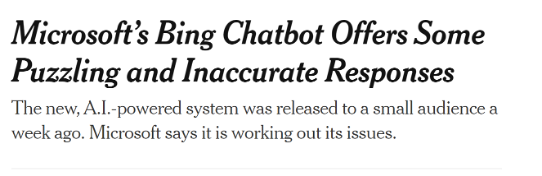
Ethical Issues

  • Labeling often depends on low-cost human labor
  • The line between economic opportunity and employment is unclear
  • May cause psychological issues for some workers

Ethical Issues
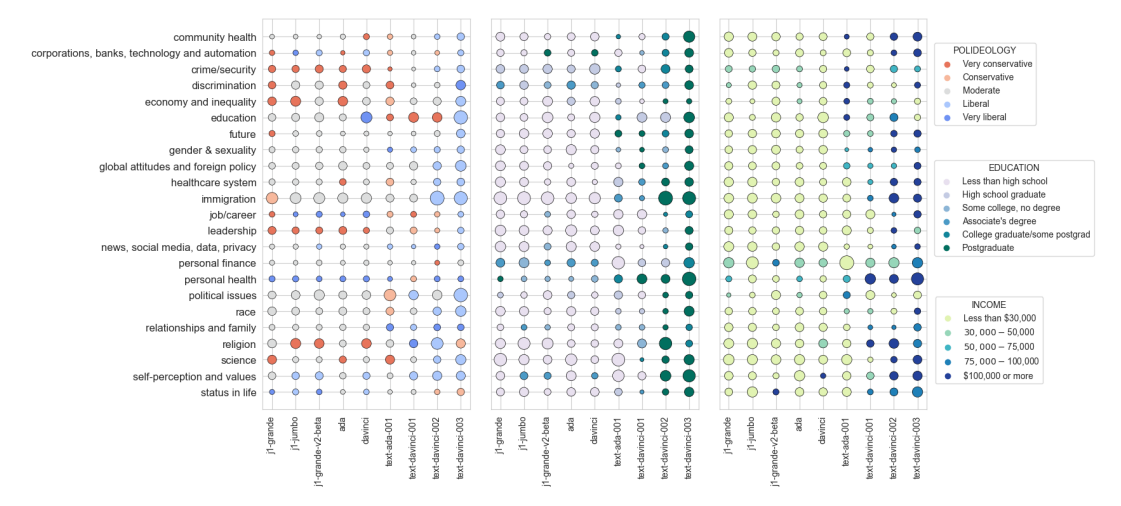
Santurkar et al. (2023)

Examples: Dueling Bandits

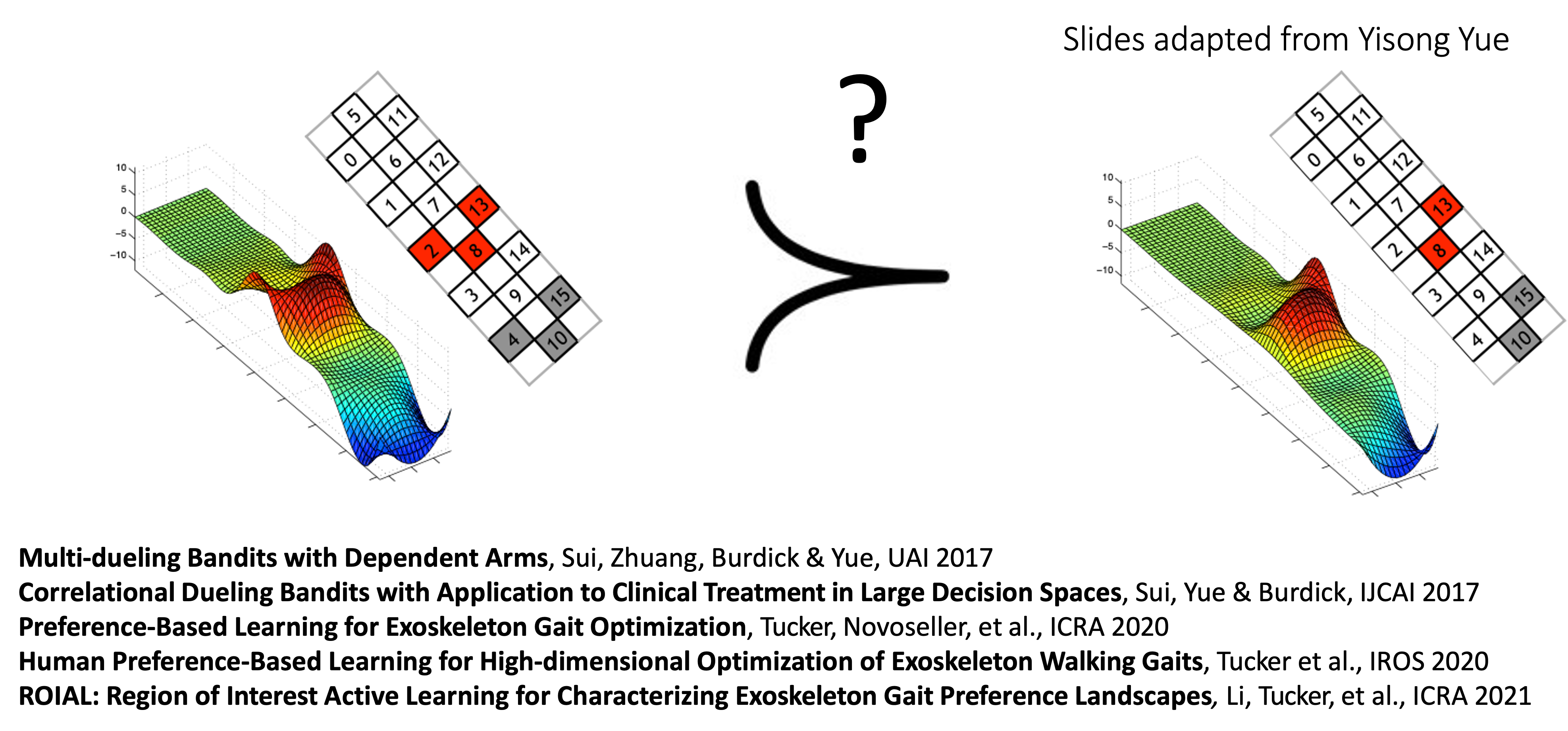
Personalize therapy
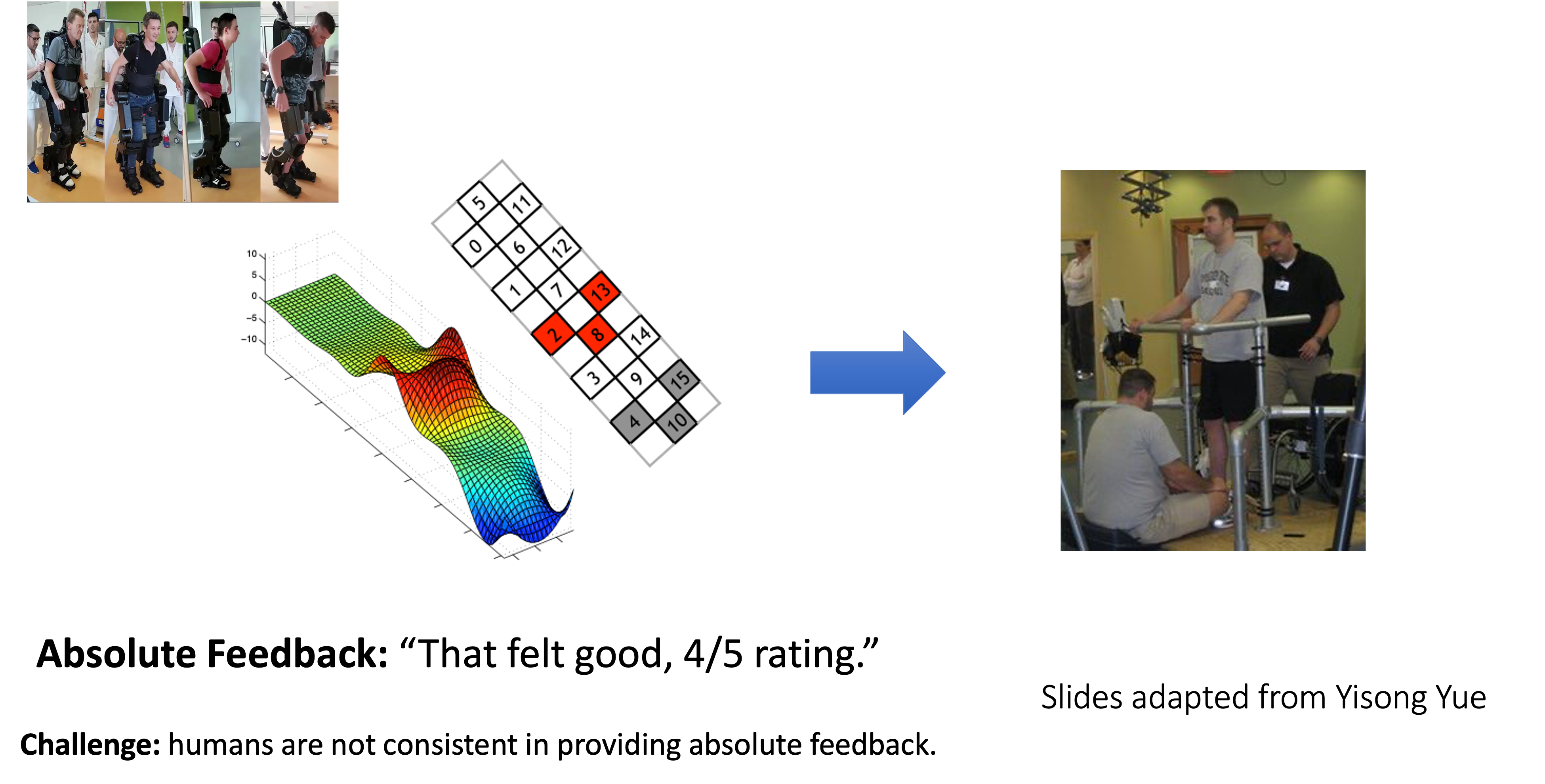
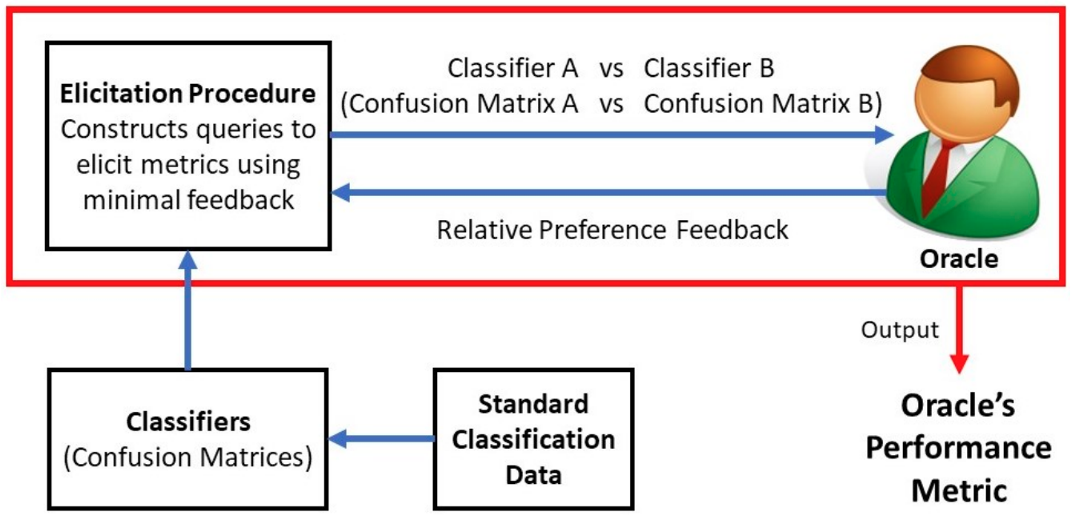
Examples: Metric Elicitation

  • Determine the fairness and performance metric by interacting with individual stakeholders (Hiranandani et al. 2019b, 2019a)
  • Metric elicitation from stakeholder groups (Robertson, Hiranandani, and Koyejo 2023)
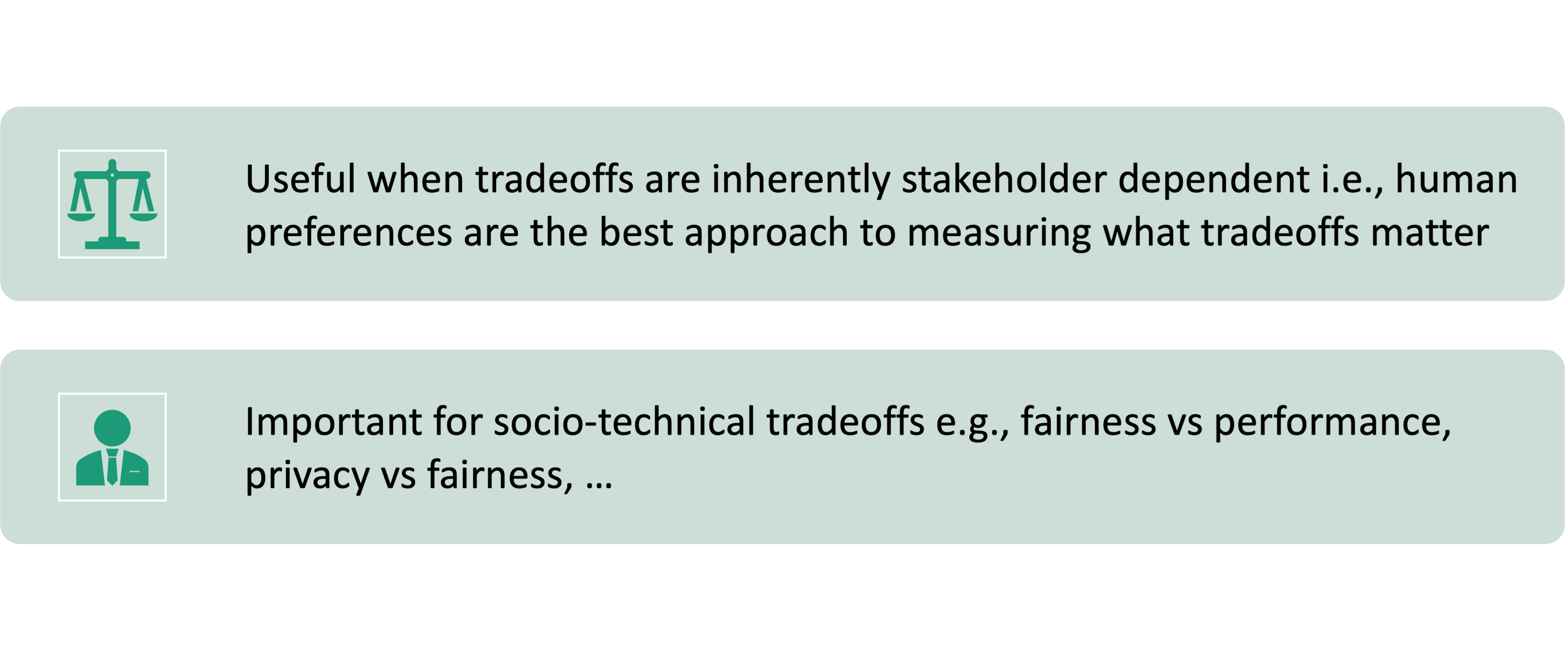
Examples: Metric Elicitation

Why elicit metric preferences?
Examples: Inverse RL
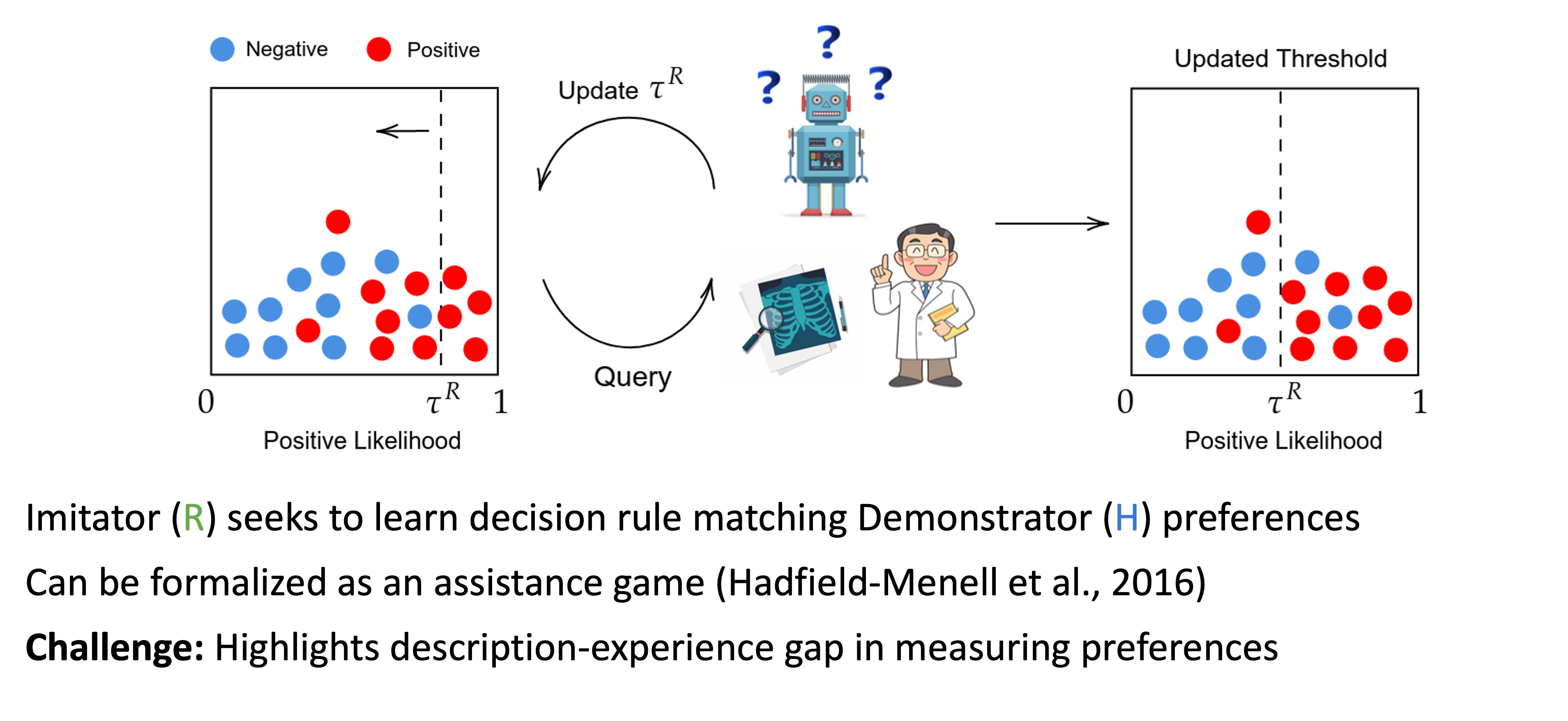
Robertson, Haupt, and Koyejo (2023)

Examples: Recommender Systems
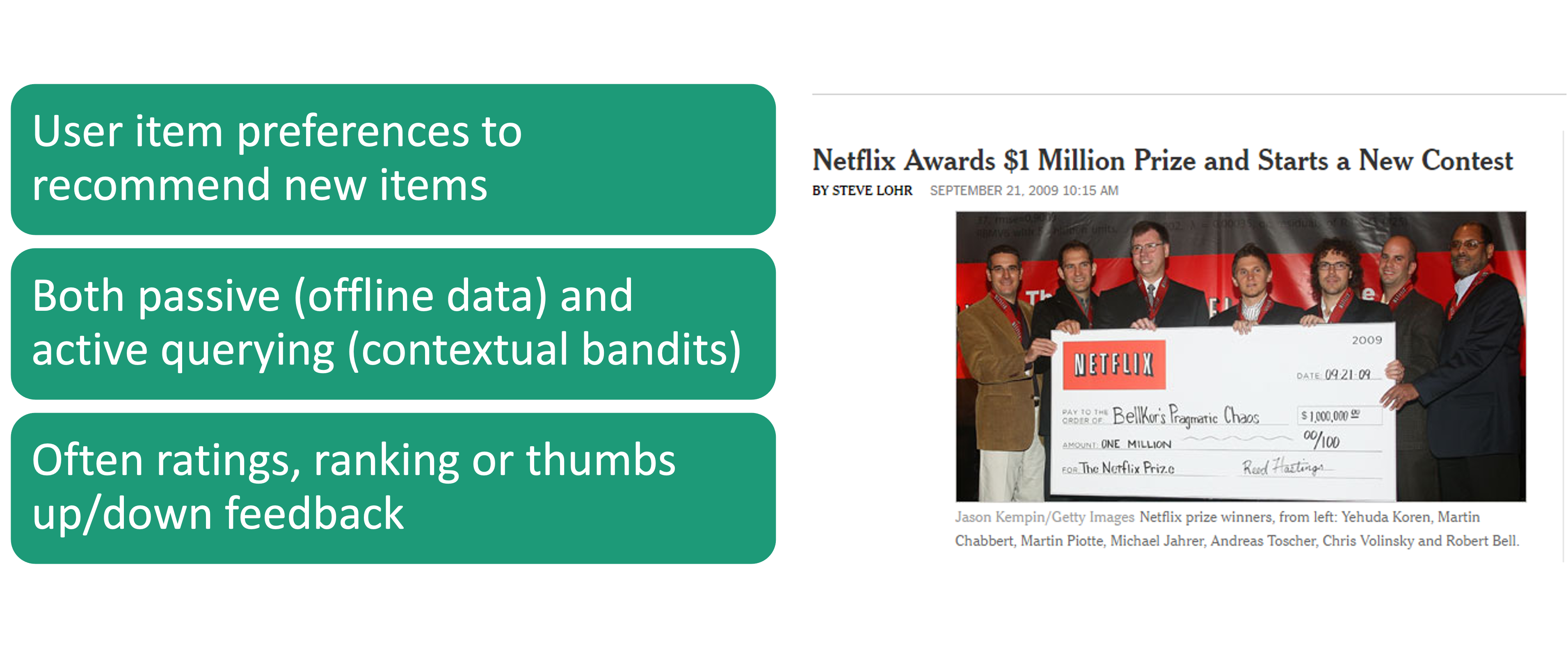
Examples: RLHF
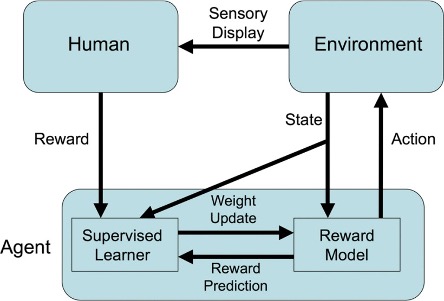
Bradley Knox and Stone (2008)
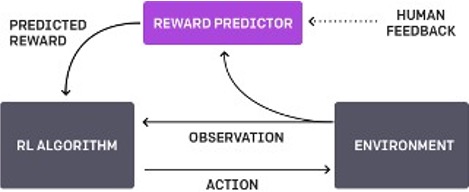
Christiano et al. (2017)

Examples: Inverse RL

Flying helicopters using imitation learning and inverse reinforcement learning (IRL)

Coates, Abbeel, and Ng (2008)

Examples: Inverse RL

Biyik and Sadigh (2018)

Examples: Inverse RL

Biyik, Talati, and Sadigh (2022)

Examples: Inverse RL

Reward hacking

Tradeoffs

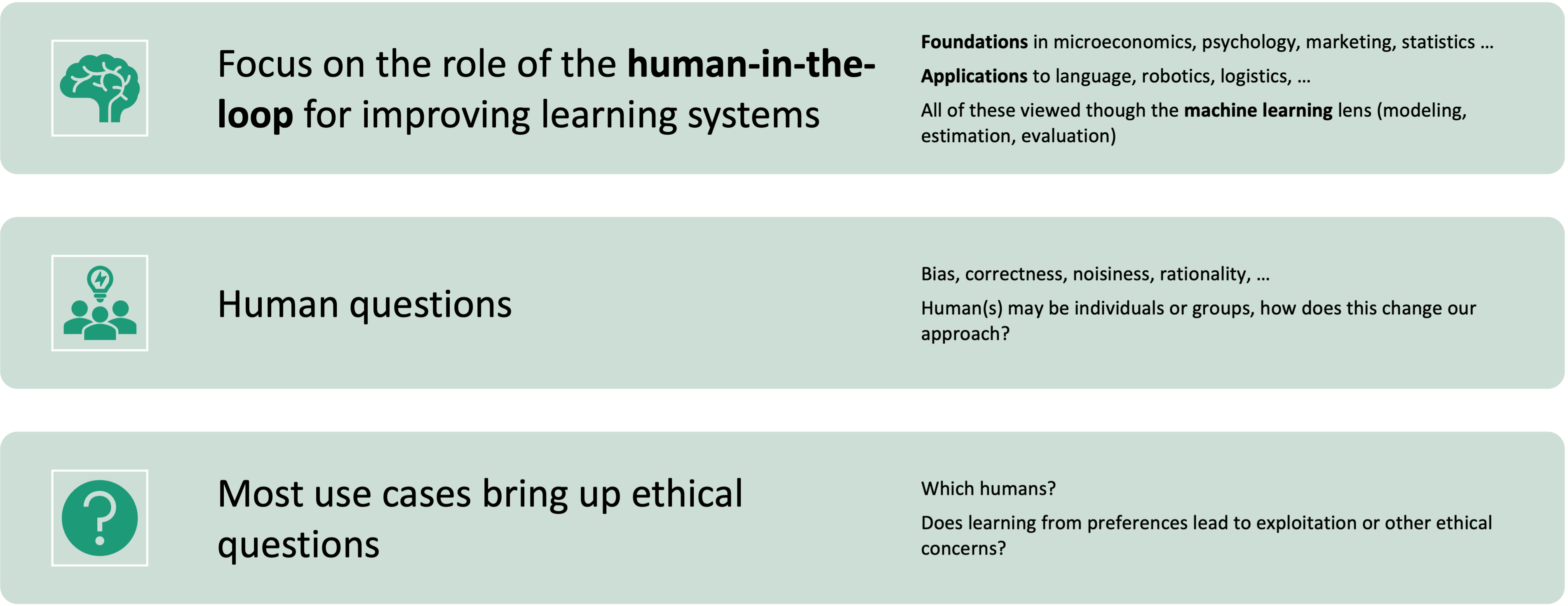
Design of tools for eliciting feedback from humans often has to tradeoff several factors
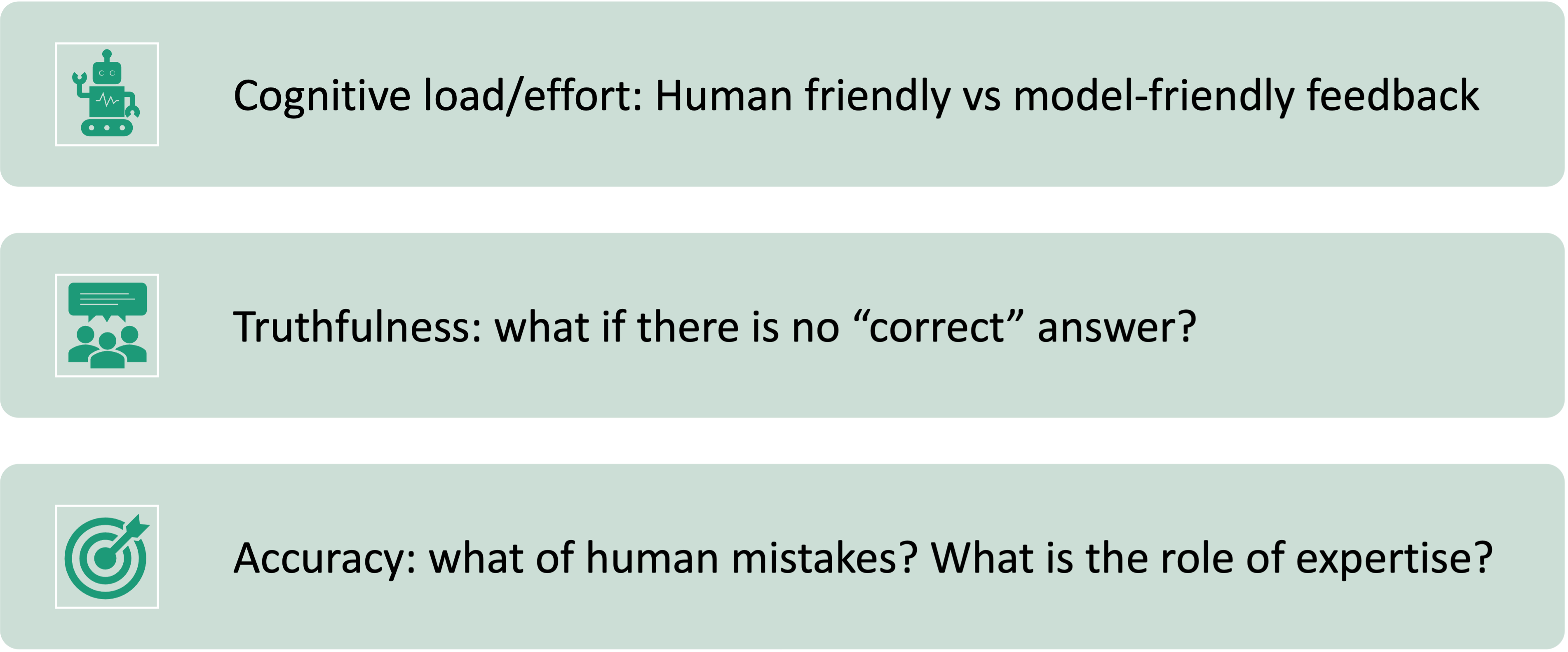
Key Assumptions & Discussion
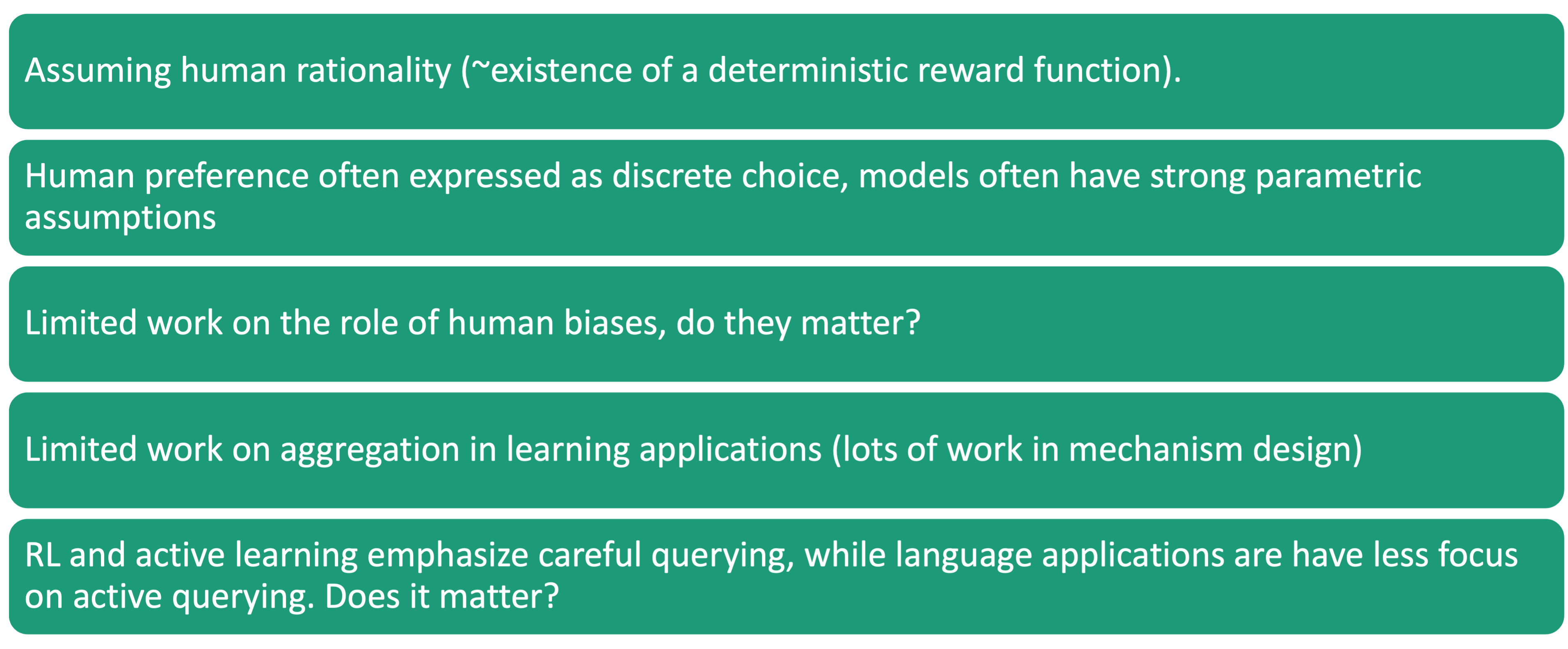
Logistics: Course Goals

  • Focus on breadth vs. depth
  • Foundations: Judgement, decision making and choice, biases (psychology, marketing), discrete choice theory, mechanism design, choice aggregation (micro-economics), human-computer interaction, ethics
  • Machine learning: Modeling, active learning, bandits
  • Applications: recommender systems, language models, reinforcement learning, AI alignment
  • Note: Schedule is tentative

Logistics: Prerequisites

CS 221, CS 229, or equivalent. You are expected to:

  • Be proficient in Python and LaTeX. Most homework and projects will include a programming component.
  • Be comfortable with machine learning concepts, such as train and test set, model fitting, function class, and loss functions.

Logistics: Books

Our textbook is available online at: mlhp.stanford.edu

Next Topics

Chapter 2: Human Decision Making and Choice Models

Welcome to CS329H!

Biyik, Erdem, and Dorsa Sadigh. 2018. “Batch Active Preference-Based Learning of Reward Functions.” In Proceedings of the 2nd Conference on Robot Learning, edited by Aude Billard, Anca Dragan, Jan Peters, and Jun Morimoto, 87:519–28. Proceedings of Machine Learning Research. PMLR. https://proceedings.mlr.press/v87/biyik18a.html.
Biyik, Erdem, Aditi Talati, and Dorsa Sadigh. 2022. “APReL: A Library for Active Preference-Based Reward Learning Algorithms.” In Proceedings of the 2022 ACM/IEEE International Conference on Human-Robot Interaction, 613–17.
Bradley Knox, W., and Peter Stone. 2008. “TAMER: Training an Agent Manually via Evaluative Reinforcement.” In 2008 7th IEEE International Conference on Development and Learning, 292–97. https://doi.org/10.1109/DEVLRN.2008.4640845.
Christiano, Paul F, Jan Leike, Tom Brown, Miljan Martic, Shane Legg, and Dario Amodei. 2017. “Deep Reinforcement Learning from Human Preferences.” Advances in Neural Information Processing Systems 30.
Coates, Adam, Pieter Abbeel, and Andrew Y. Ng. 2008. “Learning for Control from Multiple Demonstrations.” In Proceedings of the 25th International Conference on Machine Learning, 144–51.
Harpale, Abhay, Sunita Sarawagi, and Soumen Chakrabarti. 2004. “Document Classification Through Interactive Supervision of Document and Term Labels.” In European Conference on Principles of Data Mining and Knowledge Discovery, 185–96. Springer.
He, Luheng, Julian Michael, Mike Lewis, and Luke Zettlemoyer. 2016. “Human-in-the-Loop Parsing.” In Proceedings of the 2016 Conference on Empirical Methods in Natural Language Processing, 2337–42.
Hiranandani, Gaurush, Shant Boodaghians, Ruta Mehta, and Oluwasanmi Koyejo. 2019a. “Performance Metric Elicitation from Pairwise Classifier Comparisons.” In Proceedings of the Twenty-Second International Conference on Artificial Intelligence and Statistics, edited by Kamalika Chaudhuri and Masashi Sugiyama, 89:371–79. Proceedings of Machine Learning Research. PMLR. https://proceedings.mlr.press/v89/hiranandani19a.html.
Hiranandani, Gaurush, Shant Boodaghians, Ruta Mehta, and Oluwasanmi O Koyejo. 2019b. “Multiclass Performance Metric Elicitation.” In Advances in Neural Information Processing Systems, edited by H. Wallach, H. Larochelle, A. Beygelzimer, F. dAlché-Buc, E. Fox, and R. Garnett. Vol. 32. Curran Associates, Inc. https://proceedings.neurips.cc/paper_files/paper/2019/file/1fd09c5f59a8ff35d499c0ee25a1d47e-Paper.pdf.
Ouyang, Long, Jeff Wu, Xu Jiang, Diogo Almeida, Carroll Wainwright, Pamela Mishkin, Chong Zhang, et al. 2022. “Training Language Models to Follow Instructions with Human Feedback.” Advances in Neural Information Processing Systems 35: 27730–44.
Robertson, Sean, Andreas Haupt, and Sanmi Koyejo. 2023. “Cooperative Inverse Decision Theory for Uncertain Preferences.” In Proceedings of the Conference.
Robertson, Sean, Gaurush Hiranandani, and Sanmi Koyejo. 2023. “Probabilistic Performance Metric Elicitation.” arXiv Preprint.
Santurkar, Shibani, Esin Durmus, Faisal Ladhak, Cinoo Lee, Percy Liang, and Tatsunori Hashimoto. 2023. “Whose Opinions Do Language Models Reflect?” In International Conference on Machine Learning, 29971–30004. PMLR.
Stiennon, Nisan, Long Ouyang, Jeff Wu, Daniel M. Ziegler, Ryan Lowe, Chelsea Voss, Alec Radford, Dario Amodei, and Paul Christiano. 2020. “Learning to Summarize from Human Feedback.” Advances in Neural Information Processing Systems 33.